
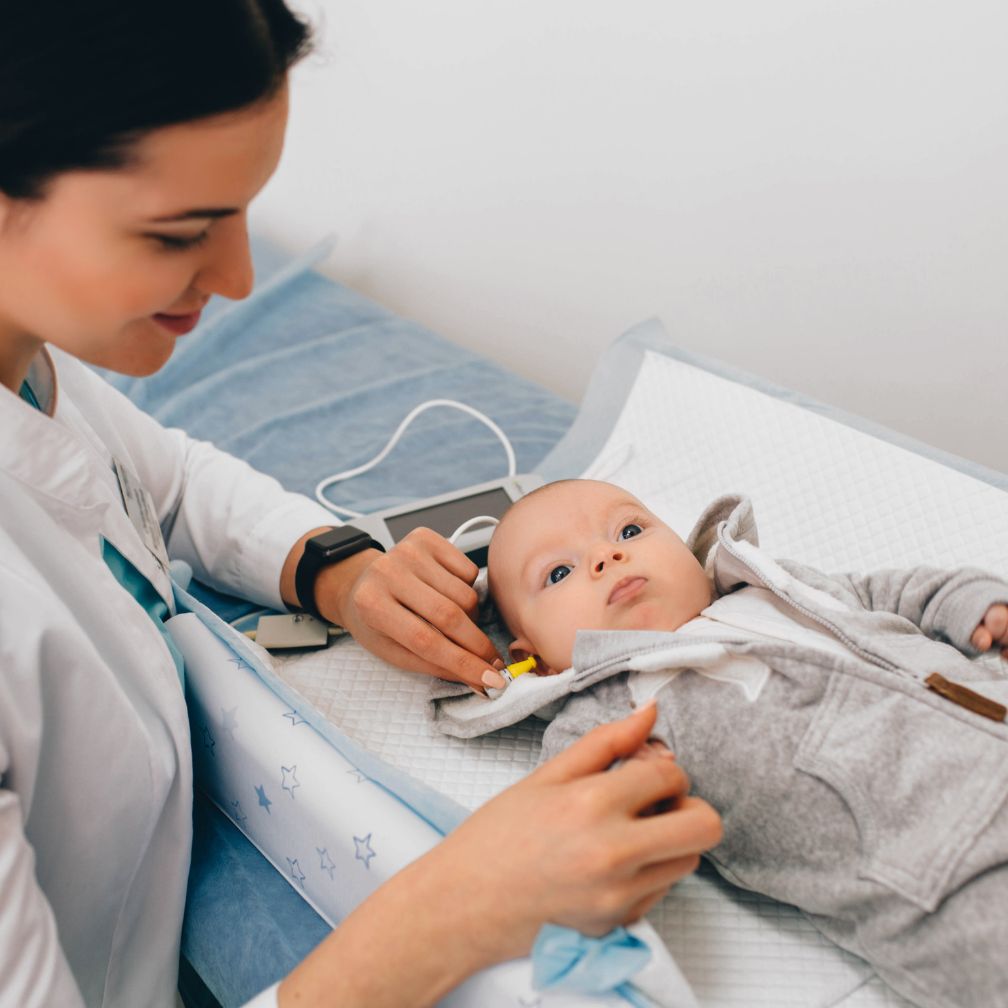
For first-time parents, discovering that their infant experiences auditory deficits can feel deeply shocking and distressing. However, the encouraging reality remains: through prompt screening and early care, infants with auditory challenges routinely attain remarkable achievements. In truth, such babies can cultivate verbal abilities, social skills, and solid bonds within their surroundings, attaining a truly rich existence!
Utilizing amplified hearing devices or surgical cochlear units provides two highly reliable options for assisting infants with auditory challenges. Further down, our article reviews their operational details so you can identify the proper choice for your baby.
Demystifying Hearing Deficits in Newborns
Early hearing loss in young infants often occurs because of various root causes, such as:
- Hereditary genetic markers (even absent any documented parental history)
- Active congenital infections including cytomegalovirus (CMV) or rubella pathogens
- Unexpected birth-related trauma, including neonate oxygen loss or premature delivery
- Selected pharmaceutical treatments deployed inside neonatal intensive units
Which measure offers the greatest impact? Prompt clinical evaluation. Because of this, newborns across the United States receive evaluations for hearing deficits before heading home. Specialized pediatric hearing clinicians advocate for the established “1-3-6” intervention timeline:
- Preliminary auditory screening completed within 30 days post-birth
- Official diagnostic verdict achieved prior to 3 months post-birth
- Targeted intervention (incorporating wearable devices or care) initiated prior to 180 days of life
Reaching these early milestones provides infants the best chance for healthy speech, language, and brain development. Should you require assistance regarding these auditory screens, your pediatrician will be happy to help!
Understanding Amplification Devices for Infants
In infants identified with mild to severe auditory loss, modern hearing aids frequently serve as the initial therapeutic step. These tiny, wearable hearing tools elevate environmental sound levels, aiding babies in discerning human speech and ambient sounds more accurately.
Dedicated pediatric-grade hearing devices represent:
- Safe for newborn infants only a few weeks after birth
- Crafted with cushioned, ergonomic ear molds that are replaced as the baby grows
- Furnished with secure battery housing closures and dedicated pediatric safety elements
- Uniquely adjusted by a trained pediatric hearing practitioner to match your child’s exact hearing needs
While your child matures, these hearing aids demand periodic adjustments to preserve physical comfort and functional efficacy.
Pediatric Cochlear Implants: An Advanced Solution
If a baby experiences severe to profound sensorineural impairment while getting minimal improvement from hearing aids, a cochlear implant is often recommended. Unlike standard acoustic hearing aids, cochlear implant devices:
- Are fitted directly inside the inner ear via surgery to directly stimulate the auditory nerve
- Successfully bypass non-working zones in the cochlea
- Process incoming sound into refined electrical impulses that activate auditory nerve fibers directly
State-of-the-art cochlear systems function as:
- Clinically cleared by the FDA for babies as young as 9-12 months of age
- Maximally beneficial when paired with early speech intervention and strong home support
- Advised exclusively after thorough diagnostic testing by an expert audiologist and ENT specialist
That multi-step journey involves radiological imaging, comprehensive audiometric testing, and conversations about long-term expectations and outcomes.
Hearing Aids vs. Cochlear Implants: What’s the Difference?
- Mild to severe auditory decline uses Hearing Aids; Severe to profound auditory destruction warrants Cochlear Implants
- Non-Invasive acoustic positioning: Hearing Aids; Invasive surgical installation: Cochlear Implants
- Traditional acoustic amplification: Hearing Aids; Digital electrical impulse transformation: Cochlear Implants
- Application starts during early infancy: Hearing Aids; Placement starts at 9-12 months: Cochlear Implants
Hearing Aids vs. Cochlear Implants: Final Thoughts
In the event your infant receives a hearing loss diagnosis, you can rely on excellent technological options alongside extensive professional backing. Under the care of specialized pediatric hearing doctors, numerous children grow to master speech and language proficiency that rivals their normal-hearing peers.
No matter if your infant proves better suited for conventional hearing aids or advanced cochlear implants, taking immediate action creates a profound lifelong advantage.
Are you looking for clarity regarding your infant’s hearing development? Contact our clinical team today to arrange a comprehensive evaluation and customized treatment program.