
Maintaining dinner dialogue proves demanding when chaotic ambient noise strains your concentration and hearing. Our specialists can evaluate hearing under both calm and noisy listening conditions to establish why noisy rooms present such difficulty. After uncovering the precise factors driving your difficult hearing, our team helps you select individualized auditory solutions.
Why Can I Hear Normally but Struggle to Listen in a Restaurant?
Calm domestic settings establish a positive signal-to-noise ratio, allowing target speech to stand out clearly from faint background noises. Dining venues establish an entirely contrary auditory challenge. Background voices, loud music, service clatter, and wall reflections collide with spoken words, demanding heightened cognitive processing to isolate individual speech.
This symptom pattern often reflects underlying high-frequency hearing loss, central processing dysfunction, or physiological aging of the auditory nerve. Dim lighting, physical tiredness, conversational distance, and divided attention exacerbate these listening deficits. Certain patients demonstrate normal sensitivity on routine audiograms while struggling significantly during advanced speech-in-noise testing. Communication breakdowns in loud restaurants should be professionally assessed even if one-on-one listening feels uncompromised.
Clinical Evaluation of High-Frequency Hearing Loss
The diagnostic workup opens with an extensive intake examining difficult listening environments, past noise trauma, tinnitus presence, family history, and medical history.
Through pure-tone audiometry, we determine your faintest auditory perception across low to high pitches utilizing both air and bone conduction testing. Sensorineural high-frequency hearing loss demonstrates an audiometric slope reflecting diminished hearing thresholds as sound frequencies climb. Comprehensive evaluations frequently include impedance tympanometry to examine middle-ear function and recorded word-recognition testing to measure speech understanding.
Because a quiet booth does not recreate a busy dining room, speech-in-noise testing can add valuable information. This procedure gauges speech-discrimination accuracy while competing multi-source noise becomes incrementally louder. Interpreted together, these clinical scores demonstrate whether listening struggles originate from loss of audibility, speech clarity deficits, auditory processing delays, or combined elements.
The Role of Central Auditory Processing Disorders in Adults
An auditory processing disorder degrades the central nervous system’s capacity to organize and interpret complex sound inputs. The peripheral auditory system may register sounds within normal limits, yet the brain falters when separating competing acoustic inputs, sorting speech sounds, or tracking fast speech. We first evaluate peripheral hearing and then determine whether an individualized auditory-processing test battery or referrals to other professionals are appropriate.
What Strategies Can Improve Hearing in Noisy Environments?
Strategic behavioral modifications can substantially improve the auditory signal reaching your ears while maximizing supportive visual cues. Prior to dining, choose venues known for lower noise levels or schedule meals during quieter dining hours. Establishments designed with high-walled booths, acoustic wall treatments, heavy fabrics, and carpeting reduce reverberation far better than modern industrial spaces with bare surfaces.
In-venue communication guidelines:
- Request table placement positioned away from dishwashing stations, bustling bars, sound speakers, and celebratory gatherings.
- Choose a seat with your back against a solid wall to block acoustic clutter originating from behind.
- Position yourself to directly face companions under bright lighting to enhance facial comprehension.
- Keep conversational proximity as close as comfortably feasible to preserve acoustic signal strength.
- Position your better-hearing ear directly toward your main conversational partner.
- Request that companions rephrase misunderstandings using different words rather than repeating the same sentence.
- Actively confirm key information rather than smiling and guessing at ambiguous dialogue.
- Excuse yourself for a momentary quiet pause when listening exhaustion starts to mount.
- Invite companions to focus on clear articulation and a measured, comfortable cadence.
- Raised or shouting voices warp acoustic phonetics and rarely improve speech intelligibility.
What Are the Best Tools for Hearing with Background Noise?
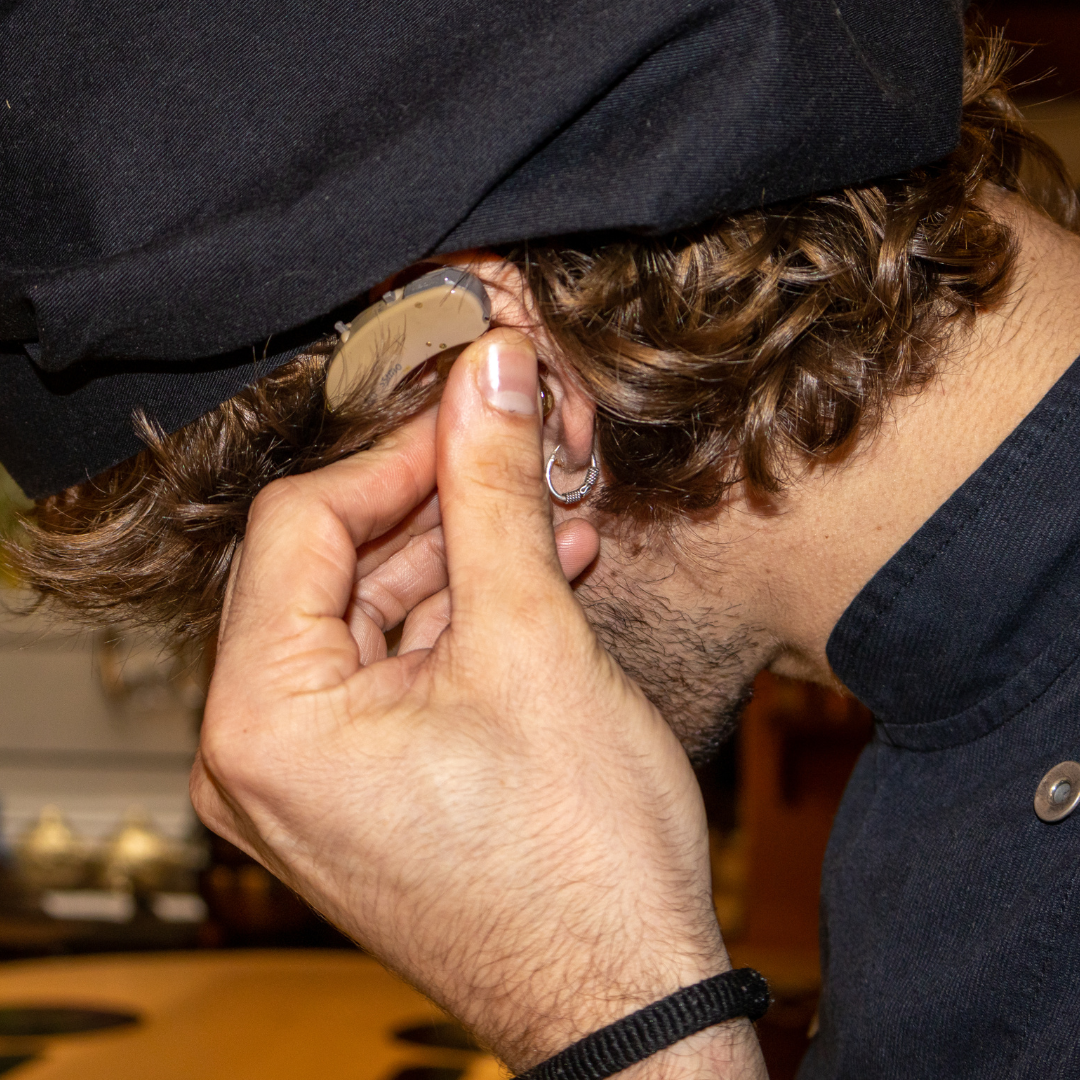
Determining the proper hearing technology hinges on the underlying disorder, everyday listening environments, and whether peripheral hearing loss is diagnosed. Professionally programmed hearing aids incorporate multi-channel directional microphones, digital noise reduction algorithms, and custom restaurant settings to capture frontal speech while attenuating background interference. They still require realistic expectations because no device can remove every unwanted voice.
Remote wireless microphones offer an exceptional boost to the signal-to-noise ratio in challenging venues. Positioned near or clipped to the speaker, the device transmits raw speech audio directly to paired hearing aids or external listening receivers. Direct audio routing minimizes the acoustic penalty of conversational distance and surrounding environmental din.
Other clinically valuable tools include:
- Wireless conference table microphones that capture multi-speaker discussions
- Hearing-loop telecoils that stream clean audio in loop-equipped establishments
- Smartphone speech-to-text or live-captioning applications
- Earbuds or hearables with compatible assistive-listening features
- Sound-level or restaurant-review tools for finding quieter locations
Our audiology staff helps you evaluate options, ensures wireless compatibility, and trains you on operating your chosen equipment.
Professional Audiological Solutions for Loud Listening Environments
A comprehensive hearing evaluation looks far beyond the common misconception of “I hear fine in quiet environments.” Our clinicians review the specific environments, vocal pitches, and decibel levels that trigger breakdowns to design a personalized test protocol. Your diagnostic appointment may incorporate pure-tone air and bone thresholds, acoustic middle-ear testing, word-recognition scores, and speech-in-noise measures. Advanced auditory-processing testing can be introduced whenever medical history and baseline assessments justify specialized evaluation.
Hearing changes that present abruptly, affect only one side, or progress rapidly necessitate consultation with an ear, nose, and throat physician. Comprehensive clinical care targets the physiological roots of hearing difficulties rather than simply writing them off as bad restaurant acoustics.
Schedule a Diagnostic Hearing Evaluation Right Away
If struggling through dinner conversation leaves you mentally exhausted, detached, or constantly guessing, schedule a complete hearing evaluation with our clinic. Our clinical team will determine the best strategies to improve your hearing in noisy environments through custom hearing-aid programming, remote microphones, or targeted auditory rehabilitation.
Get in touch with our team to request an appointment and rediscover confident, stress-free restaurant conversations.